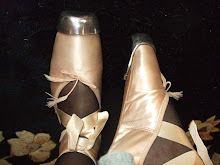
A good friend of mine has a repeating calf muscle problem .She most likely has not see someone to fully deal with the problem. So, I am going to give her a few ideas to try and help her.
Since toetap or pointe/tap have the similar calf issues as clogging,pointe. Also share some of the same injury's as high heels or pointe boots. I am going to share a few calf issues.
This one from Answerbag goes like this :
Calf muscle injury's acour in either the gastrocnemius or the soleus muscle.The gastrocnemius is the large ,more obvious calf directly below the knee. The soleus lies directly below it and,is attached to the Achillies tendon. The most calf injury's are caused by overuse durning activity's such as basketball,footballweightlifting,or dancing.
Significance:
Calf muscle injurys can be serious or disabling as they affect a persons ablitity to walk.
Idenification:
Calf muscle injury are categorized in grades 1,2 or 3 accourding to the Sports injury Clinic.
Grade 1
Are mild strains that cause mild pain and tightness
Grade 2
can cause swelling and brusing as well as pain while walking.
Grade 3
Is the most sever ..such as a torn muscle or ruptured tendon.
Effect
A grade 3 rupture can cause a deformity in the calf as the muscle tendon becomes detached from the Achillies heel and ,bunches up at the top of the leg just below the knee. Someone with this type of injury may not be able to contract his muscle.
Surgical repair is often necessary.
Type of Non Surgical Treatment:
Most calf sprains are pulled muscles that can be treated witha combination of rest,ice,heat and anti-inflammatory medicans such as ibuprofen,aspirin ,naproxen,Etodolac, Tramadol,Cyclobezaprine....they even have a few that will get you down the montain the day before yesterday!Yes ! they can be that strong!
You can also, weara heel pad to lesson the preasure on the two major calf muscles.
Considerations:
Once the intial inflammation is under control .Use heat to increase blood flow to the injuried calf muscle. Heat helps relax the muscle and,get them ready for renewed physical activity. Stretching and strenth building exercises can also help.
Here was another Answer :
The plantaris Muscle is a thin muscle that starts at the knee joint. Which attaches to the Plantaris tendon beginning at the calf.
The Plantaris tendon then elongates down the calf to the foot.Connected to the joints in the foot.
Both the Plantaris muscle and,tendon are prone to injury.Because they are connected to two joints .
This answer came from a clogging site :
Calf tightness can be due to several factors:
1) Are you dehydrated?
You need to ensure that you are drinking enough water to allow the exersing muscle to work.
2) A lot of calf related systoms are due to faulty foot mechanics. Which have existed for many years without a problem. But , now are coming to light.
As a result the calf maybe working too hard to compansate for these mechanic and become excessively tight. but, stretches on there own is not the answer .
See a podiatrist for a gait(I.E. walking,running,dance) analysis and they will be able to explain exactly what is wrong. Do not except stretching as the answer it is not!
Answer from my P.T.
People who do clogging ,pointe ,or toetap share the same calf injury's as a person who wears high heels .
To be sure I would have to see her .
I know for a fact that they have very good P.T. 's where she from .
Recommened books to read :
Preventing Dance Injuries
second edition
by Ruth Solomon
John Solomon and
Sandra Cerny Minton
Dance Anotomy and Kinesiology
by Karen S. Clippinger
Dance Imagery for Technique and Performance
By Ana Bracilovic
Showing posts with label dance injury's. Show all posts
Showing posts with label dance injury's. Show all posts
Tuesday, January 18, 2011

Sunday, January 16, 2011
Common Dance injury's part Two
In this post I am going to write about two common dance injury's to the foot . That could be avoided by common sense and good foot care.
The first one is plantar fasclitis.
Plantar Fasclitis: Is by definition "is a overuse injury effecting the sole of the foot.
Most common complaint is the foot hurts when I walk barefoot .Especially first thing in the morning.
What happens is the tough ,fibrous band of tissue (fascia). That connects the heel bone to the base of the toes. Becomes inflamed and painful.
For dancer's
Will often experience an increase in pain after class.
or after a long weight bearing activities.
Plantar Fascia pain can also, be influenced by tightness in the calf,
or the Achilles Tendon ,
or dancing on a hard surface or a non-sprung floor
The Treatment
The earlier this is detected the quicker it is done with.
Rest and Ice are the first treatment for this
Anti-inflamatory medican is helpful
If this condition continues seek a PT's help or
a Athletic training treatment is a good idea
If this becomes a Chronic people responed well to a overnight splint
of course issued by a doctor
The next one I want to talk about is a conidition know as Metatarsalgia
Metatarsalgia:
Most common complaint is pain over the balls of the feet
What is this condition?
Metatarsalgia is pain and tenderness along the ball of the foot. For dancers, this is commonly caused by unstable joints in the smaller toes.
How did it happen?
Repeated sprains and overstreached ligaments can lead to laxity, or a increased flexibility in theses joints.
What is ligament laxity?
Is defined as simply as loose ligaments. Wikipedia defines it as a condition know as
Ligamentous laxity Which is "in a normal body the ligaments connect bones and allow a normal range of motion. With laxed ligaments the range is increased . A examble would be double jointed elbow or knee
In a Dancer years of overworkand forcing extreme motion in the foot can increse laxity.
Also may cause subluxation of theses joints
Subluxation is definded as a partial dislocation
Treatment:
Rest and Ice since this is a inflamatory condition
Strengthening the muscles that control toe flexion
How?
can be done with towel scrunches.
Place a towel on the ground..then use your toes to grab it while drawing it towards you.
A PT will most likely use a metatarsal pad placed just behind the balls of the feet can help prevent subluxation.
it also, may help relive the pain
The first one is plantar fasclitis.
Plantar Fasclitis: Is by definition "is a overuse injury effecting the sole of the foot.
Most common complaint is the foot hurts when I walk barefoot .Especially first thing in the morning.
What happens is the tough ,fibrous band of tissue (fascia). That connects the heel bone to the base of the toes. Becomes inflamed and painful.
For dancer's
Will often experience an increase in pain after class.
or after a long weight bearing activities.
Plantar Fascia pain can also, be influenced by tightness in the calf,
or the Achilles Tendon ,
or dancing on a hard surface or a non-sprung floor
The Treatment
The earlier this is detected the quicker it is done with.
Rest and Ice are the first treatment for this
Anti-inflamatory medican is helpful
If this condition continues seek a PT's help or
a Athletic training treatment is a good idea
If this becomes a Chronic people responed well to a overnight splint
of course issued by a doctor
The next one I want to talk about is a conidition know as Metatarsalgia
Metatarsalgia:
Most common complaint is pain over the balls of the feet
What is this condition?
Metatarsalgia is pain and tenderness along the ball of the foot. For dancers, this is commonly caused by unstable joints in the smaller toes.
How did it happen?
Repeated sprains and overstreached ligaments can lead to laxity, or a increased flexibility in theses joints.
What is ligament laxity?
Is defined as simply as loose ligaments. Wikipedia defines it as a condition know as
Ligamentous laxity Which is "in a normal body the ligaments connect bones and allow a normal range of motion. With laxed ligaments the range is increased . A examble would be double jointed elbow or knee
In a Dancer years of overworkand forcing extreme motion in the foot can increse laxity.
Also may cause subluxation of theses joints
Subluxation is definded as a partial dislocation
Treatment:
Rest and Ice since this is a inflamatory condition
Strengthening the muscles that control toe flexion
How?
can be done with towel scrunches.
Place a towel on the ground..then use your toes to grab it while drawing it towards you.
A PT will most likely use a metatarsal pad placed just behind the balls of the feet can help prevent subluxation.
it also, may help relive the pain
Subscribe to:
Posts (Atom)